
-
 Lori Walsh/SDPBProfessor David Swanson, Ph.D., explains the fascinating ways South Dakota songbirds survive the winter weather.
 -
 A new book explores the history of America through the lens of evergreen trees. SDPB talks with Trent Preszler about the science of evergreens and the human cost of industrial excess.


-
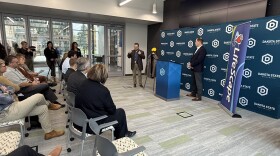 A collaboration between Dakota State University and LifeScape is aimed at developing innovative clothing to protect workers with a common material: plastic.
 -
 The matter may be dark, but the minds are bright at the upcoming STEAM Café in Rapid City, hosted by the South Dakota School of Mines.
 -
 Hundreds of students in Sioux Falls had the opportunity to learn about STEM education and meet with South Dakota State University professors and students at the Washington Pavilion this weekend.
 -
 A research project at the Sanford Underground Research Facility, or SURF, hits a milestone after scientists restarted the program.
 -
 South Dakota Mines is receiving nearly $2 million to recruit and support graduate students studying research in advanced materials.
 -
 The Sanford Underground Research Facility, or SURF, is hosting the 17th annual Neutrino Day in Lead on Saturday. The citywide festival includes science activities, cultural performances and talks with SURF scientists and engineers.
 -
 A mile under the Black Hills, science is happening with the potential to change humanity’s understanding of the universe and our place within it. At the Sanford Underground Research Facility – or SURF – any number of these experiments can have ramifications that go well beyond South Dakota.
 -
 Landsat 7, the first Landsat to downlink data to the ground station in South Dakota, is officially decommissioned.SDPB had a conversation at the Earth Resources Observation and Science Center, or EROS, in Sioux Falls with two men who worked with the satellite.
 -
 Dakota State University received a $1 million grant from Google to host a cybersecurity clinic. Officials say the clinic is improving cybersecurity in the state and abroad.
 -
 Crews are outfitting massive underground caverns at the Sanford Underground Research Facility in the northern Black Hills to study neutrinos. The Long Baseline Neutrino Facility has two caverns that are 500 feet long, 92 feet high and 65 feet wide. Those caverns will host cryostats filled with 17,000 tons of liquid argon to catch one of the universe’s fundamental particles.


